A dip workout is an excellent exercise that can be done anywhere and anytime, provided you have a support structure. Typically, when the weather gets warm, we tend to gather with friends at the local schoolyard, where we find the simplest equipment, such as bars, pull-up bars, and parallel bars. I must say that it was on parallel bars where I developed my chest muscles like no other exercise could!
In this article, I will talk about three types of dip exercises that will help you quickly develop your shoulder, chest, and triceps muscles. In other words, you can improve your entire upper body with dips!
Dips are a basic exercise that develops several muscle groups. They are perfect for building strength, strengthening and increasing muscle mass in the shoulders, chest, and triceps. The main focus is on the chest and triceps muscles, as well as the front part of the deltoid muscles (under the armpits).
Classic Dips
 Classic dips are designed to develop the muscle groups mentioned above. To perform them, grip the bars with your hands and hang on them with your arms fully extended above the floor, with your knees bent. The head should be slightly lowered, and the gaze should be directed downwards. This is because having your head raised or tilted can significantly reduce the quality of the exercise and make you expend more energy. Start by bending your arms at the elbows, slightly leaning forward with your body. It is important to bend your arms only at a 90-degree angle to avoid excessive stretching of the triceps. When lowering yourself, slightly spread your elbows to the sides. The key here is not to hunch but to squeeze your shoulder blades together and arch your back. Exhale as you push yourself back up, and inhale as you lower yourself.
Developing Chest Muscles with Dips
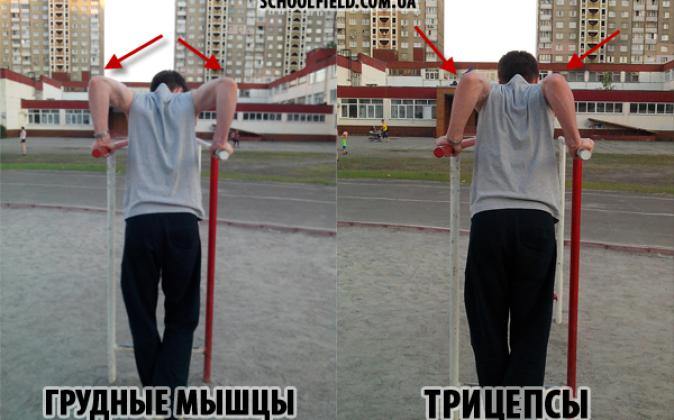
Depending on how you perform dips, you can place more emphasis on certain muscles. For example, if you lean forward more and spread your elbows slightly wider, you will focus more on developing your chest muscles. However, it is important to lower yourself carefully to avoid stretching your chest muscles, as your muscles may not be able to support your body weight on the last repetitions, causing you to collapse. Pay attention to your technique, as quality is more important than quantity. These dips are especially effective when done with additional weight, which should be added gradually. It is worth noting that unlike with a barbell, you do not need a spotter with dips. At any time, you can jump off the bars to the ground if necessary.
It is very effective and in a short time, you can pump up your triceps by doing dips on parallel bars, without leaning forward and keeping the elbows strictly behind. This almost completely isolates the load on the triceps muscle, which in my opinion is much better than the French press, especially if you do it outdoors (I hope you will do it outside), as you will be amazed at the results. Also, try to train not alone, but in the company of like-minded people, as the competitive element will increase the effectiveness at least one and a half to two times.
A real-life example: Once, a "pumped-up gym guy" joined our group. We hooked him up to the pull-up bar where four of us were already playing. The strongest of us did seventeen reps before we immediately moved on to the parallel bars. Starting with five reps, three of us added an extra 8kg weight. As a result, those without additional weight did 20-23 reps, while those with an extra load stopped at 15-18 reps. Our guest then admitted that he had never pushed himself this much in the gym before.
Safety precautions. When doing dips on parallel bars, it is important to avoid certain mistakes. Perhaps the most important is swinging. You start to swing when the main part of the dips is done, your strength is depleted, but you want to do "just a little bit more"! It is better to do fewer reps, but with proper technique than to try to squeeze out everything. Swinging can lead to serious strains and injuries, which no one needs. It is also important to watch your elbows. If your elbows start to spread too far apart, it is very harmful to your joints. For this reason, if it is difficult to control the abduction of the elbows, it is better to keep them strictly behind.